![Top 5 Consulting Firms Specializing in Logistics Industry R&D [Latest 2026]](https://growth-marketing-lab.com/marketing/wp-content/uploads/2025/08/common_02-1-1024x576.jpg)
Logistics R&D is complex and costly. The right consulting partner accelerates innovation, reduces risk, and drives efficiency. Here are the top 5 firms leading logistics research and development in 2026.
What Is R&D Consulting in the Logistics Industry?
Defining Research and Development in Logistics — From Automation Equipment to Process Innovation
Research and development in logistics spans automation equipment design to process innovation. R&D focuses on developing new products and improving efficiency. Companies rely on consultants with a deep understanding of supply chain systems, manufacturing processes, and emerging technologies to advance their research and development strategies effectively.
The Three Types of R&D That Drive Logistics Optimization Algorithms and New Solutions
Three core R&D types drive logistics innovation. Basic research builds scientific knowledge. Applied research targets new products and solutions. Development research improves existing processes for efficiency gains. Global R&D funding reached almost $1.7 trillion, reflecting how seriously organizations across various industries are investing in research and development programs.
Why Logistics Companies Are Investing in R&D Consulting to Advance Labor-Saving Technology
R&D is a high-risk, long-term investment. It can cost over $2 billion and take 17 years. Machine learning and artificial intelligence help reduce costs and accelerate innovation. Consulting firms support companies in developing strategies that innovate processes, manage risk, and drive measurable efficiency gains across logistics sectors.

Overview of the Top 5 R&D Consulting Firms for Logistics Companies
CONNECTABLUE, Inc.
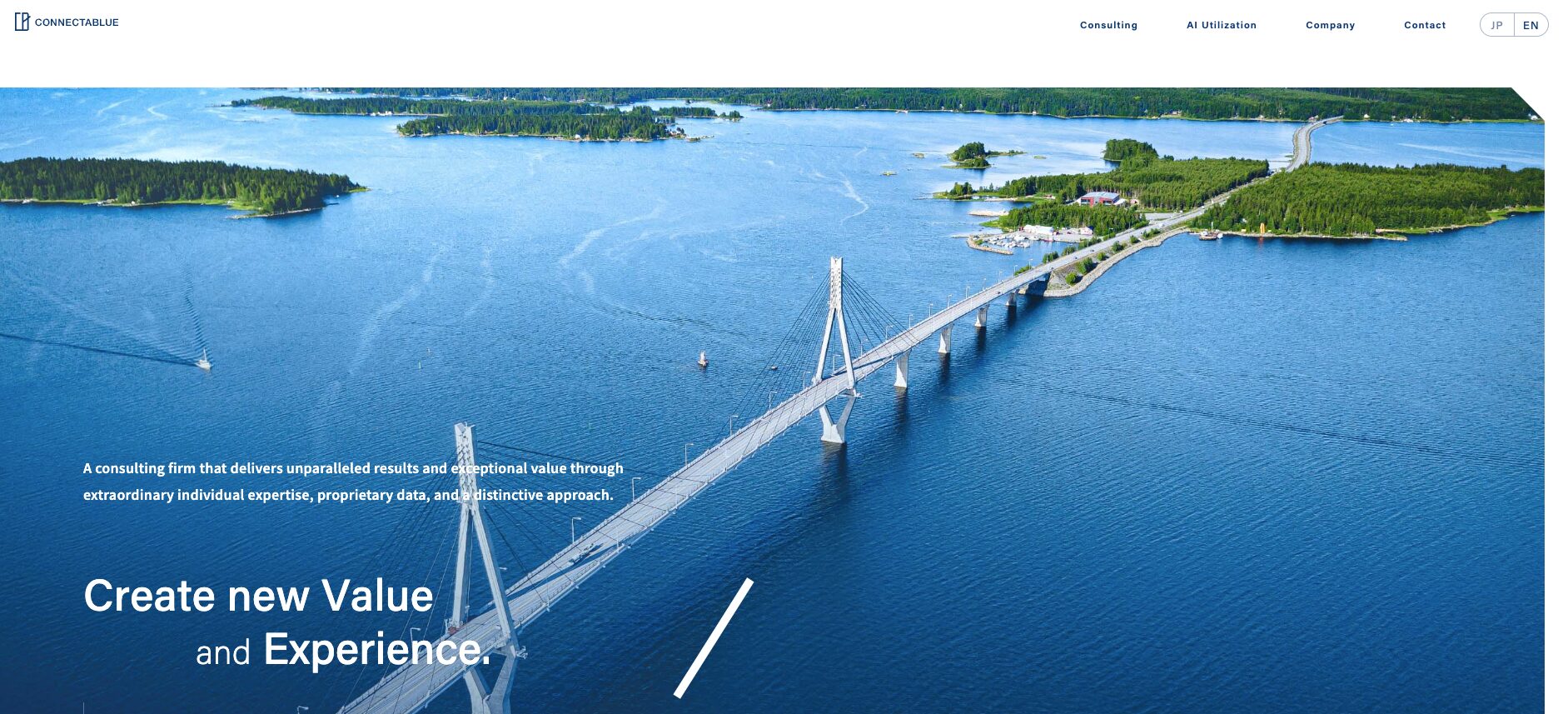
Company / Service Overview
ConnectaBlue Inc. is a consulting firm that supports clients end-to-end across R&D, from Theme Exploration and Technology Strategy formulation to Innovation creation, commercialization, and R&D Investment optimization. By applying proprietary AI tools and digital marketing methods to high-resolution exploration of market Needs, the company accelerates the early detection and validation of latent opportunities. It has extensive experience in manufacturing industries, including automotive and semiconductor, as well as trading companies, construction, and the IT industry, and has a broad track record serving both large enterprises and mid-sized companies.
Its proprietary AI tools combine multiple AI models that interact with one another to maximize analytical precision. These tools explore prospective technology fields across multiple time horizons, comprehensively investigating and estimating potential research themes, commercialization difficulty, sources of competitive advantage, obtainable market share, revenue scale, growth potential, and ease of implementation. This approach helps identify new possibilities that conventional methods often overlook. In addition, the company maintains a global network of more than 500 technical professionals, enabling further refinement of AI-identified themes by incorporating tacit human knowledge.
Within just one to two months, the company can perform thousands to tens of thousands of investigations and estimates, dramatically reducing the time required for conventional Technology Strategy development and research Theme Exploration while maximizing precision. This methodology has been highly valued by clients such as major materials manufacturers, chemical companies, and general electronics manufacturers, contributing to a continuation rate of over 90%. The company also brings strong capabilities in data utilization, labor-saving technology, automation equipment, and logistics optimization algorithms where relevant to R&D and new business development.
Features
- High-resolution Theme Exploration powered by proprietary AI tools and digital marketing applications
- Highly reliable decision-making support through anonymous information gathering and Needs analysis
- Extensive experience and strong capabilities in Technology Strategy and Innovation support for industrial sectors, including chemicals and materials
- A global network of more than 500 technical professionals, maximizing value through the combination of human tacit knowledge and AI
- Support for evaluating opportunities from multiple perspectives, including Investment efficiency, data utilization, ease of implementation, labor-saving technology, automation equipment, and logistics optimization algorithms
Achievements / Case Studies
- Developed a roadmap for automation technology for the R&D division of a company in the logistics industry and promoted proof-of-concept testing for next-generation systems (Revenue scale: JPY 1.5 trillion)
- Formulated an open Innovation strategy for the new business development division of a trading company and achieved commercialization of three initiatives (Revenue scale: JPY 600 billion)
- Introduced an agile R&D process to the EV development division of a company in the automotive industry, shortening the prototyping period by six months (Revenue scale: JPY 4 trillion)
| 会社名 | CONNECTABLUE, Inc. |
|---|---|
| 本社 所在地 |
LAPiS Aoyama II 5F, 2-4-8 Minami-Aoyama, Minato-ku, Tokyo |
Boston Consulting Group
Company / Service Overview
Boston Consulting Group (BCG), as a comprehensive consulting firm that has supported corporate transformation across countries worldwide, provides end-to-end support in the R&D domain, from strategy formulation to execution and organizational adoption. BCG drives R&D transformation directly linked to business growth, including technology strategy and portfolio optimization, research theme creation, development process reform, and improvement of development productivity through digital and AI utilization, with a strong track record of supporting major companies across a wide range of industries such as manufacturing, healthcare, technology, and materials.
BCG integrates market- and customer-driven product strategy with technology roadmaps, and holistically designs the advancement of R&D investment decision-making, the optimal design of stage-gate and agile processes, organizational and governance reform, and the strengthening of talent and skills. Furthermore, BCG implements transformation in a way that takes root on the ground, including the development of data infrastructure, the introduction of AI for discovery and simulation, and the utilization of engineering IT such as PLM and ALM, thereby achieving both shorter development lead times, higher success rates, and optimized costs.
Key Features
- Optimizes R&D portfolios and roadmaps by integrating technology strategy, product strategy, and investment allocation
- Improves both development productivity and quality by combining development process reform with digital and AI utilization
- Provides hands-on execution support that extends to organization, governance, and talent development, with a focus on sustainable adoption in the field
| 会社名 | Boston Consulting Group |
|---|---|
| 本社 所在地 |
25F Nihonbashi Muromachi Mitsui Tower, 3-2-1 Nihonbashi Muromachi, Chuo-ku, Tokyo, Japan |
KPMG Consulting Co., Ltd.
Company / Service Overview
KPMG Consulting is a full-service consulting firm that leverages KPMG’s global expertise and network to support companies across the entire research and development (R&D) domain, from strategy formulation to execution and institutionalization. The firm provides support aimed at optimizing overall R&D management, including R&D portfolio design aligned with technology and market trends as well as business strategy, theme exploration and planning, development process transformation, data utilization, organizational and talent development, and governance enhancement.
Rather than stopping at conceptual planning, KPMG Consulting promotes higher R&D productivity and more advanced decision-making through process design tailored to actual operational realities and the use of digital technologies. Through initiatives such as the development of PLM/ALM and other foundational platforms, centralized management of experimental, testing, and knowledge data, stronger stage-gate operations, and the use of AI and analytical technologies, the firm helps achieve shorter development lead times, improved quality, and greater reuse. In addition, KPMG Consulting provides hands-on support focused on execution that connects research outcomes to business value, including intellectual property and regulatory compliance, coordination with supply chains and manufacturing, and the design of alliances and open innovation.
Features
- End-to-end support from R&D strategy and portfolio design to initiative execution and governance
- Combines PLM/data platforms and AI utilization to enhance development productivity and decision-making sophistication
- Promotes transformation from a commercialization perspective, including intellectual property, regulatory compliance, and coordination with manufacturing and supply chains
| 会社名 | KPMG Consulting Co., Ltd. |
|---|---|
| 本社 所在地 |
1-9-1 Otemachi, Chiyoda-ku, Tokyo, Japan |
Daiwa Institute of Research Ltd.
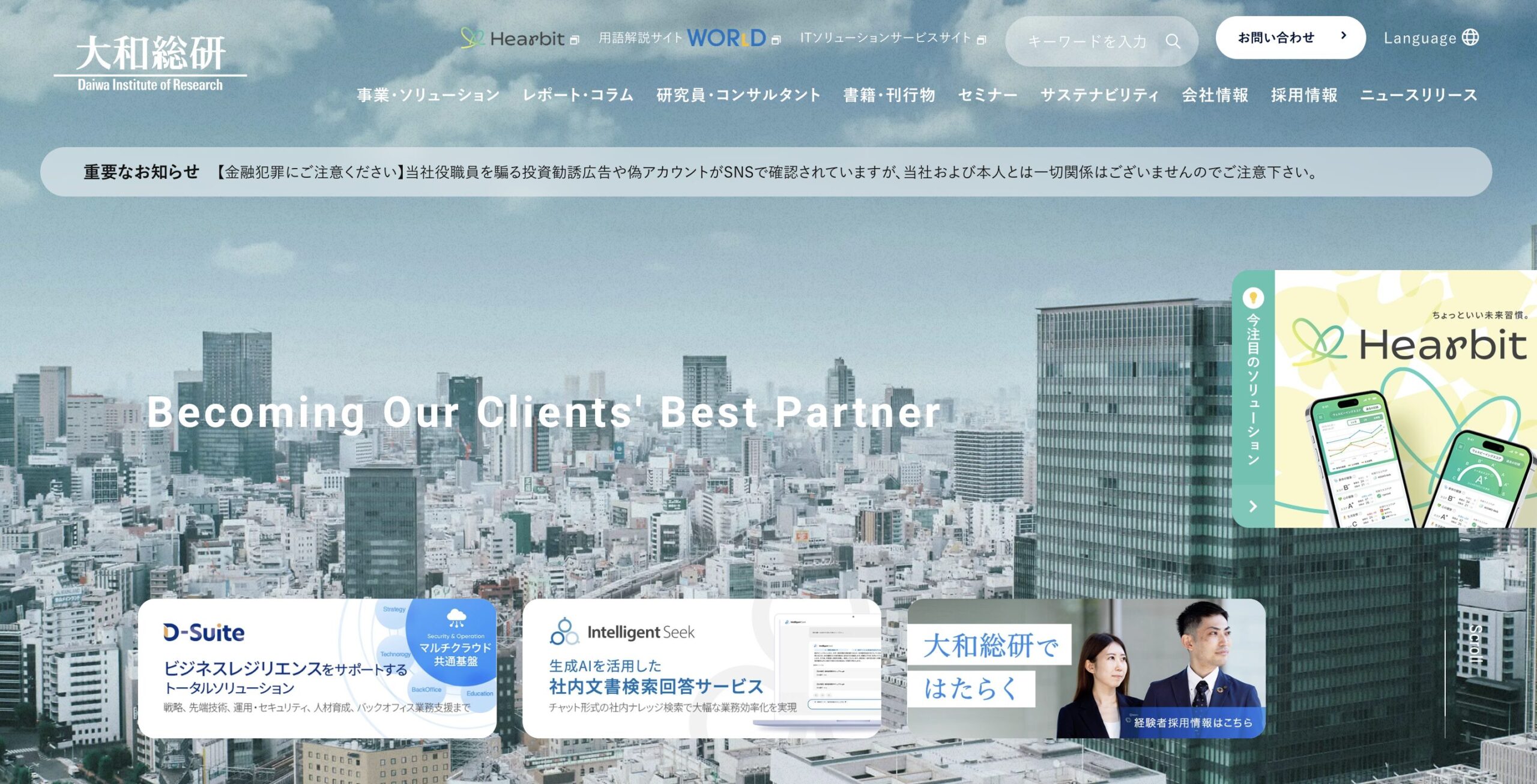
Company / Service Overview
Daiwa Institute of Research, as the comprehensive think tank of the Daiwa Securities Group, provides services that support the promotion of corporate R&D (research and development) by identifying changes in society and industry, with a particular focus on finance. It places emphasis on providing end-to-end support, from the investigation and analysis of advanced technologies to the design of themes with commercialization in mind, the planning and execution of PoCs (proofs of concept), and the development of data utilization platforms, thereby connecting R&D outcomes to on-site implementation and business value.
In the technology domain, it leverages expertise in AI/data science, cloud computing, cybersecurity, blockchain, and other fields to support designs and evaluations that can withstand real-world operations, based on the quality and governance requirements expected at the level of financial institutions. In addition, by combining the research capabilities of a think tank with system development and consulting execution capabilities, it enables practical R&D promotion that goes beyond technological novelty to include commercialization, regulatory compliance, risk assessment, operational design, and return on investment.
Key Features
- End-to-end support from research and concept planning to PoC, implementation, and operational adoption
- R&D design and evaluation based on finance-grade governance and security standards
- Hands-on support that goes beyond a technology-driven approach to include commercialization, regulatory compliance, and risk assessment
| 会社名 | Daiwa Institute of Research Ltd. |
|---|---|
| 本社 所在地 |
15-6 Fuyuki, Koto-ku, Tokyo, Japan |
PwC Consulting LLC
Company / Service Overview
PwC Consulting LLC is a comprehensive consulting firm that provides integrated support from strategy formulation through execution and adoption. In R&D support, the firm offers cross-functional assistance spanning technology strategy and portfolio design, R&D process transformation, data utilization and digitalization, and talent and organizational design, with the aim of strengthening research and development while also driving business growth. Leveraging expertise across a wide range of industries, including manufacturing, life sciences, technology, and energy, PwC promotes optimization of the entire value chain—including planning, design, production, and services—as a company-wide transformation that goes beyond the R&D function alone.
Rather than stopping at conceptual planning, PwC works alongside clients through PoC (proof of concept), use-case creation, governance design, tool selection and implementation, and operational adoption, thereby enabling shorter R&D lead times, improved development efficiency, stronger quality and compliance, and more advanced decision-making for exploratory themes. Through the use of AI/analytics, PLM/MES, digital threads/digital twins, and other technologies, PwC supports the transition to highly reproducible R&D management by establishing R&D data infrastructure and utilization platforms.
Key Features
- End-to-end support from technology strategy and R&D portfolio planning to execution and adoption
- Strong capabilities in R&D digitalization and governance design, including AI, data utilization, and PLM
- Optimization of company-wide value creation processes starting from R&D, leveraging cross-industry expertise
| 会社名 | PwC Consulting LLC |
|---|---|
| 本社 所在地 |
1-2-1 Otemachi, Chiyoda-ku, Tokyo, Japan |

Leading Consulting Firms Driving Logistics Industry Research and Development
McKinsey & Company — Strategic Innovation Through Data Utilization and Supply Chain R&D
McKinsey helps logistics companies build data-driven research and development strategies. Their engineers and consultants identify efficiency gains across supply chains, applying machine learning to advance new products and reduce costs through structured R&D programs.
Boston Consulting Group — Advancing Logistics Automation Equipment and Open Innovation Strategies
BCG supports logistics innovation through open innovation partnerships and automation-focused development consulting. Their research programs help companies develop new services, improve manufacturing processes, and deploy machine learning solutions that drive measurable efficiency across operations.
Accenture — Ease of Implementation in Intelligent Operations and Logistics R&D Programs
Accenture’s consultants specialize in developing scalable R&D solutions for logistics organizations. Their intelligent operations research programs integrate AI and machine learning, helping companies innovate rapidly while managing risk and reducing time consuming development cycles.
Deloitte — Technology Strategy Built on Logistics Optimization Algorithms and Regulatory Insight
Deloitte combines deep understanding of logistics regulations with advanced R&D strategies. Their consultants support companies in developing optimization solutions, improving processes, and accessing R&D tax credits that reduce investment costs across various industries.
Gartner — Research-Led Investment Guidance for Labor-Saving Technology in Logistics
Gartner provides research-led advisory services that help logistics companies stay ahead by evaluating labor-saving technologies. Their data and market knowledge guide strategic R&D investment decisions, helping organizations prioritize innovation and achieve long-term development success.

How R&D Consulting Firms Help Logistics Companies Innovate and Grow
Developing New Products and Services Through Data Utilization and Machine Learning
Consulting firms help logistics companies leverage data and machine learning to develop new products and new services that directly address market demand. R&D teams collaborate with engineers to translate operational data into innovations that improve efficiency and reduce costs.
Reducing Risk and Accelerating Innovation With Logistics Optimization Algorithms and Proven Frameworks
R&D is a high-risk investment, but proven frameworks and optimization algorithms help logistics companies innovate faster while controlling costs. Failure is a common part of the research and development process, yet structured approaches significantly improve the probability of reaching market-ready solutions efficiently.
Addressing Logistics Business Needs With Automation Equipment and AI-Driven R&D Strategies
AI-driven R&D strategies enable logistics companies to deploy automation equipment that delivers sustainable efficiency gains across manufacturing and distribution operations. Consultants support organizations in developing solutions that innovate continuously, improving processes and advancing new products aligned with evolving business and market challenges.

The Cost and Investment Value of Logistics R&D Consulting Services
Understanding R&D Consulting Costs and the Role of Tax Credits in Offsetting Investment
Logistics R&D consulting fees typically range from 10 million to 100 million yen annually, depending on project scope and firm size. R&D tax credits can reduce tax obligations by 6% to 8%, and government support through federal programs helps companies offset significant upfront costs. Israel spent 6.02% of its GDP on R&D in 2022, reflecting how seriously leading economies treat innovation investment. The IRS offers R&D tax credits to encourage innovation, making strategic consulting more financially accessible for logistics organizations across various industries.
Measuring Efficiency Gains and ROI From Labor-Saving Technology and R&D Programs
Strong R&D efforts lead to increased market share and higher profitability. Logistics companies that invest in labor-saving technology and machine learning-driven development programs consistently report measurable efficiency gains in manufacturing, routing, and warehouse processes. R&D funding reached a record high of almost $1.7 trillion globally, underscoring its role as a core business strategy. Tracking ROI requires evaluating both cost reductions and new services developed through research and development R&D initiatives.

How to Choose the Right R&D Consulting Partner for Your Logistics Organization
Key Criteria for Evaluating Consulting Firms — Ease of Implementation and Technical Depth
When selecting R&D consulting partners, logistics companies should assess ease of implementation alongside technical depth. Consultants must demonstrate experience deploying solutions across relevant sectors, supported by engineers skilled in machine learning and logistics optimization. Evaluate firms on their ability to advance development programs without creating time consuming delays or escalating costs beyond projected budgets.
Aligning R&D Innovation Strategy With Your Logistics Company’s Long-Term Business Goals
Effective R&D contributes to product innovation and builds a competitive advantage only when aligned with long-term business objectives. Discuss your organization’s development priorities with prospective partners, focusing on how their strategies support new products, efficiency improvements, and data-driven processes. Companies that stay ahead rely on consultants who understand both scientific research methodologies and real-world logistics challenges to deliver lasting innovation success.

FAQ
What is R&D consulting in the logistics industry?
In the complex logistics sector, professional research and development consulting helps companies innovate and optimize their supply chain ecosystems. Indeed, Research and Development (R&D) fosters innovation and improves existing products. Furthermore, R&D focuses on both new products and improving internal processes to boost efficiency. To accelerate these technological efforts, open innovation involves partnering with external entities to enhance R&D efforts. This specialized consulting ensures that logistics firms benefit when they deploy new products and streamline global supply chain flows to meet modern delivery demands. Working with top experts ensures seamless execution.
What does an R&D consultant do for logistics companies?
An expert development consulting agency guides modern businesses through rapidly evolving supply chains. These specialist advisors help corporate clients improve productivity across all transport operations. To do this effectively, R&D teams collaborate to translate market needs into marketable products. Additionally, R&D allows businesses to adapt to emerging trends and technological advancements. Ultimately, effective R&D contributes to product innovation and builds a competitive advantage, ensuring logistics players remain prominent market leaders. These experts ensure organizations navigate transitions with ease.
Which consulting firms specialize in logistics research and development?
Top specialized consulting firms provide dedicated research and development r support across various countries. Globally, R&D funding reached a record high of almost $1.7 trillion globally. Although pharmaceutical companies spend the most on R&D across industries, logistics-specific firms are rapidly rising to optimize delivery networks. Indeed, R&D spending reached $937 billion in the US in 2023. These specialized consulting firms guide supply chain leaders through complex, large-scale projects to secure funding and establish strong operations. This guidance helps organizations mitigate risk.
What are the top consulting firms for logistics innovation?
Leading consulting firms help logistics operators in various industries stay ahead of the competition by modernizing their infrastructure. For global context, R&D constitutes an average of 2.2% of global GDP as of 2015. On a corporate scale, Amazon spent $88.54 billion on R&D in 2024. Nationally, Israel spent 6.02% of its GDP on R&D in 2022. Top consultancies help companies benchmark against these giants to implement cutting-edge supply chain technologies and advanced warehouse automation. This benchmark is crucial for future development.
How can logistics companies benefit from R&D consulting services?
By partnering with professional advisors who possess a deep understanding of logistics, shipping firms achieve substantial efficiency gains. Research shows that strong R&D efforts lead to increased market share and higher profitability. Furthermore, R&D is critical for preventing obsolescence and ensuring long-term survival. Consultants help realize this because R&D enhances competitive advantage by creating unique, high-quality products. With expert guidance, businesses can confidently navigate complex supply chain disruptions and secure a stable market position. This strategic partnership drives long-term success.
What is the role of the research and development department in logistics?
The research and development department drives logistics progress by optimizing how employees handle freight and manage warehouse systems. Their structured efforts ensure continuous improvement. Indeed, the R&D lifecycle involves structured, iterative processes from ideation to scale-up. Consequently, the key stages of the R&D lifecycle include ideation, research, design, prototyping, and product updates. Additionally, improving existing products is a key part of R&D activities to sustain high service standards and reduce operating costs. These teams streamline workflow processes.
How do consulting firms help logistics companies develop new products and services?
Consultants help design and launch new services by analyzing materials and workflow constraints. They align market demands with operational capabilities. Crucially, market-driven discovery aligns R&D with customer feedback for effective product development. This approach protects investments, as successful R&D often results in patents and proprietary technology. Additionally, new product R&D adapts to rapid changes in consumer demands, keeping logistics providers agile, highly responsive, and prepared for future e-commerce challenges. This enables firms to capture new revenue streams.
What are the three types of R&D used in the logistics sector?
Logistics firms apply three distinct research methods, combining science and engineering to improve their operations. First, basic research aims for a fuller understanding of concepts. Second, applied research focuses on developing new products with specific goals. Third, development research improves current products and processes. Moreover, R&D is crucial for developing new products and improving existing ones. Consultants help partition these methods to optimize resource allocation and maximize the impact of every project. This structured framework yields optimal results.
How much does logistics R&D consulting cost and is it worth the investment?
Logistics R&D is a time consuming process. Notably, R&D can take around 17 years and cost over $2 billion, and R&D typically takes around 17 years and costs over $2 billion. R&D requires significant upfront investment with uncertain returns. Furthermore, R&D is a high-risk, long-term investment characterized by experimentation. Indeed, 53% of clinical trials require protocol amendments after initiation. Failure is a common part of the R&D process but can lead to efficiency in reaching market-ready products. Fortunately, government support can include resources like federal R&D tax credits to offset costs. The IRS offers R&D tax credits to encourage innovation. Ultimately, R&D tax credits can reduce tax obligations by 6% to 8%. Professional consulting helps navigate these processes smoothly.
How do machine learning and artificial intelligence improve logistics R&D strategies?
Consultants use machine learning and artificial intelligence to design smarter supply chains. By analyzing vast historical datasets, these advanced technologies predict demand patterns, automate sorting operations, and forecast bottleneck risks. This digital integration helps logistics companies optimize delivery routes, reduce transit times, and lower fuel consumption. These intelligent tools enable faster testing of new strategies, transforming traditional operations into highly responsive systems that adapt to real-time market changes. This tech-driven approach guarantees a significant competitive edge.