![Top 5 High-Precision Grinding Micro-Shaft Manufacturers in Japan [Latest 2026]](https://growth-marketing-lab.com/marketing/wp-content/uploads/2025/08/common_11-1024x683.jpg)
Discover Japan’s top precision grinding micro-shaft manufacturers. This guide covers key processes, industries, certifications, and how to choose the right partner for your project.
What Is High-Precision Grinding for Micro-Shafts and Why Does It Matter?
High-precision grinding is a machining process that uses abrasive wheels to remove material from a workpiece, achieving tolerances as tight as +0.00025 inches and exceptionally smooth surface finishes. For micro-shafts, precision grinding is essential — even sub-micron dimensional errors can cause bearing failures, motor vibration, or surgical instrument malfunction. Japanese precision grinding manufacturers combine advanced CNC machinery, rigorous quality assurance processes, and decades of expertise to deliver reliable micro-shaft components across aerospace, medical, and automotive industries.
Key Grinding Processes Used in Micro-Shaft Manufacturing: Centerless, Cylindrical, and Lapping
Centerless grinding enables higher throughput without part fixation, making it ideal for high-volume micro-shaft production. Cylindrical grinding is ideal for external surfaces of rotationally symmetric workpieces, maintaining tolerances within 0.0002 inches. Lapping and honing complete surface finishing where ultra-smooth textures are required.
How Precision Grinding Compares to Milling and Turning for Small Shaft Components
Turning and milling remove material efficiently but cannot achieve the surface finishes or tolerances that precision grinding delivers. Grinding routinely achieves Ra 0.05 μm and diameter tolerances within ±0.001 mm, far surpassing what milling or turning processes can guarantee for micro-shaft components.
What Tolerances and Surface Finishes Can Precision Grinding Achieve for Micro-Shafts?
Precision grinding achieves tolerances as tight as +0.00025 inches for diameter control. High-precision cylindrical grinding machines maintain tolerances within 0.0002 inches. Combined with lapping and honing, manufacturers can guarantee surface roughness values of Ra 0.05 μm or better for demanding industries.

About POC-SNB: Japan’s Specialist in High-Precision Grinding Micro-Shaft Solutions
SANWA NEEDLE BEARING CO., LTD.
Company / Service Overview
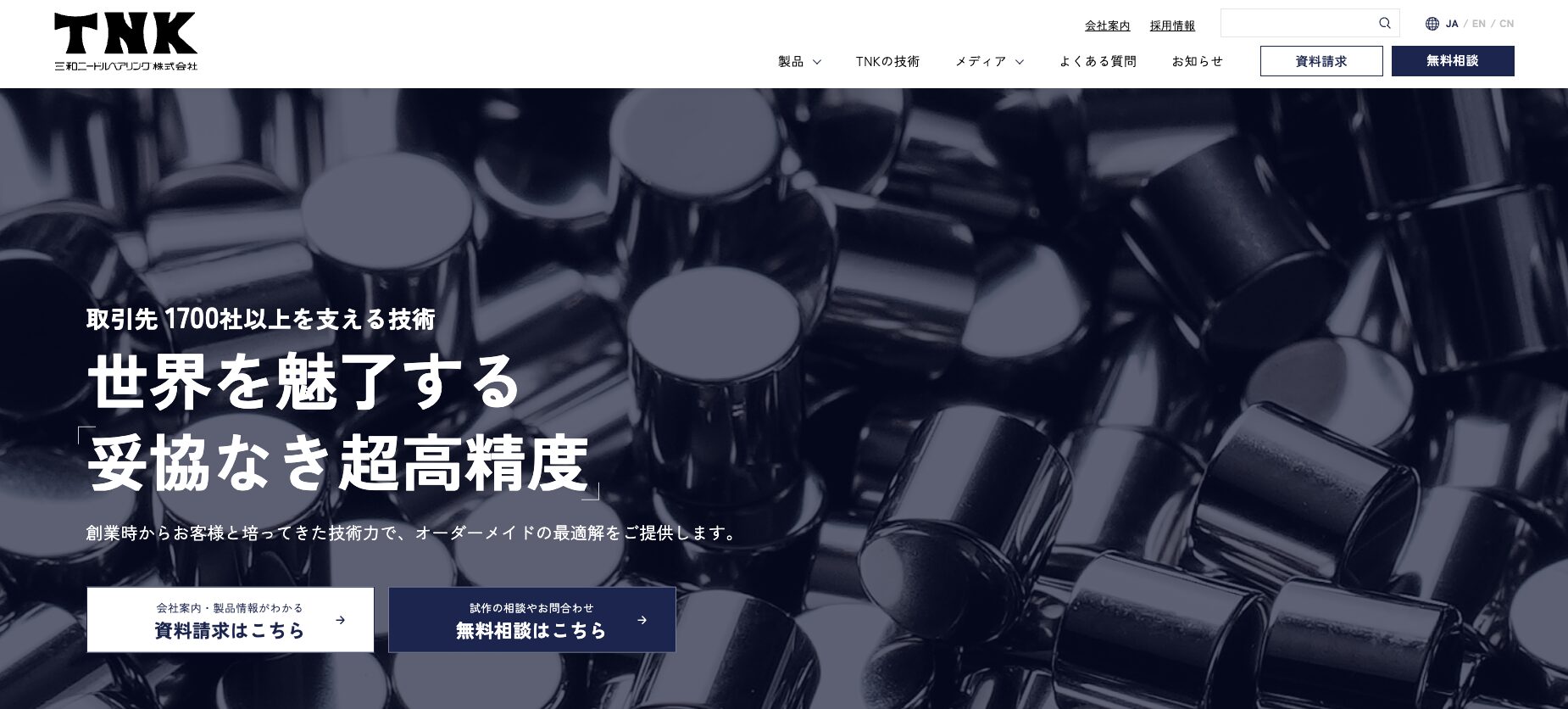
SANWA NEEDLE BEARING CO., LTD. (TNK) is a precision metal components manufacturer founded in 1946. Its core business is the production of a wide range of precision metal parts, including precision micro shafts, and its major customers include leading Japanese manufacturers such as DENSO, Mitsubishi Heavy Industries, Mitsubishi Electric, IHI, MinebeaMitsumi, and Harmonic Drive Systems. Headquartered in Tsukuba City, Ibaraki Prefecture, TNK established a production base in China as early as 1994, making it one of the first Japanese SME suppliers to build a global manufacturing structure at an early stage.
With its mission of solving customers’ “manufacturing dilemmas,” TNK pursues a world of ultra-precision machining at the level of one ten-thousandth of a millimeter. In addition to standard materials, the company provides integrated support from the proposal of optimal materials, including the ultrafine-grained stainless steel “nanoSUS®,” to prototyping and mass production. TNK also delivers stable quality in the manufacture of highly challenging components such as high-precision rollers and hollow rollers. Through exhibitions in the medical device field and proactive expansion into overseas markets, the application scope of its precision machining technology continues to grow across automobiles, electrical equipment, aerospace, and other advanced industries.
Features
- Leverages ultra-precision machining technology at the level of one ten-thousandth of a millimeter to provide stable supply of highly challenging components such as precision micro shafts and high-precision rollers
- Offers integrated support from optimal material selection proposals to prototyping and mass production, comprehensively solving customers’ manufacturing challenges
- Has a global production and BCP-ready structure utilizing its China base, backed by long-term business relationships with major Japanese manufacturers
| 会社名 | SANWA NEEDLE BEARING CO., LTD. |
|---|---|
| 本社 所在地 |
1904 Kamioshima, Tsukuba-shi, Ibaraki |
JTEKT Corporation
Company / Service Overview
JTEKT Corporation is a major machinery manufacturer that develops products and technologies supporting a wide range of industrial fields, with a focus on automotive components, bearings, machine tools, and steering systems. As one of the core companies in the Toyota Group, it provides value across diverse sectors including the automotive industry, industrial machinery, energy, and social infrastructure, leveraging the machining technology, precision control technology, and mass production technology it has cultivated over many years. Another major characteristic is its global business presence, with production, sales, and development bases located around the world.
Its main products, including electric power steering systems, various bearings, and machine tools, are adopted by many automobile manufacturers and manufacturing companies, backed by their high quality and reliability. In recent years, the company has also been focusing not only on deepening its existing businesses but also on developing new technologies and providing solutions in response to market changes such as the electrification of mobility, autonomous driving, and the advancement of manufacturing sites. By utilizing the technologies and know-how cultivated in manufacturing environments, JTEKT is strengthening its presence as a company that contributes to solving social issues and advancing industry.
Features
- Possesses advanced technological capabilities across a wide range of fields, including steering systems, bearings, and machine tools
- Maintains a diverse customer base centered on the automotive industry, extending to industrial machinery and infrastructure fields
- Provides high-quality, highly reliable products by leveraging its global network of bases and mass production technology
| 会社名 | JTEKT Corporation |
|---|---|
| 本社 所在地 |
15F Asahi Seimei Hommachi Bldg., 1-4-24 Honmachi, Chuo-ku, Osaka-shi, Osaka |
NIPPON THOMPSON CO., LTD.
Company / Service Overview
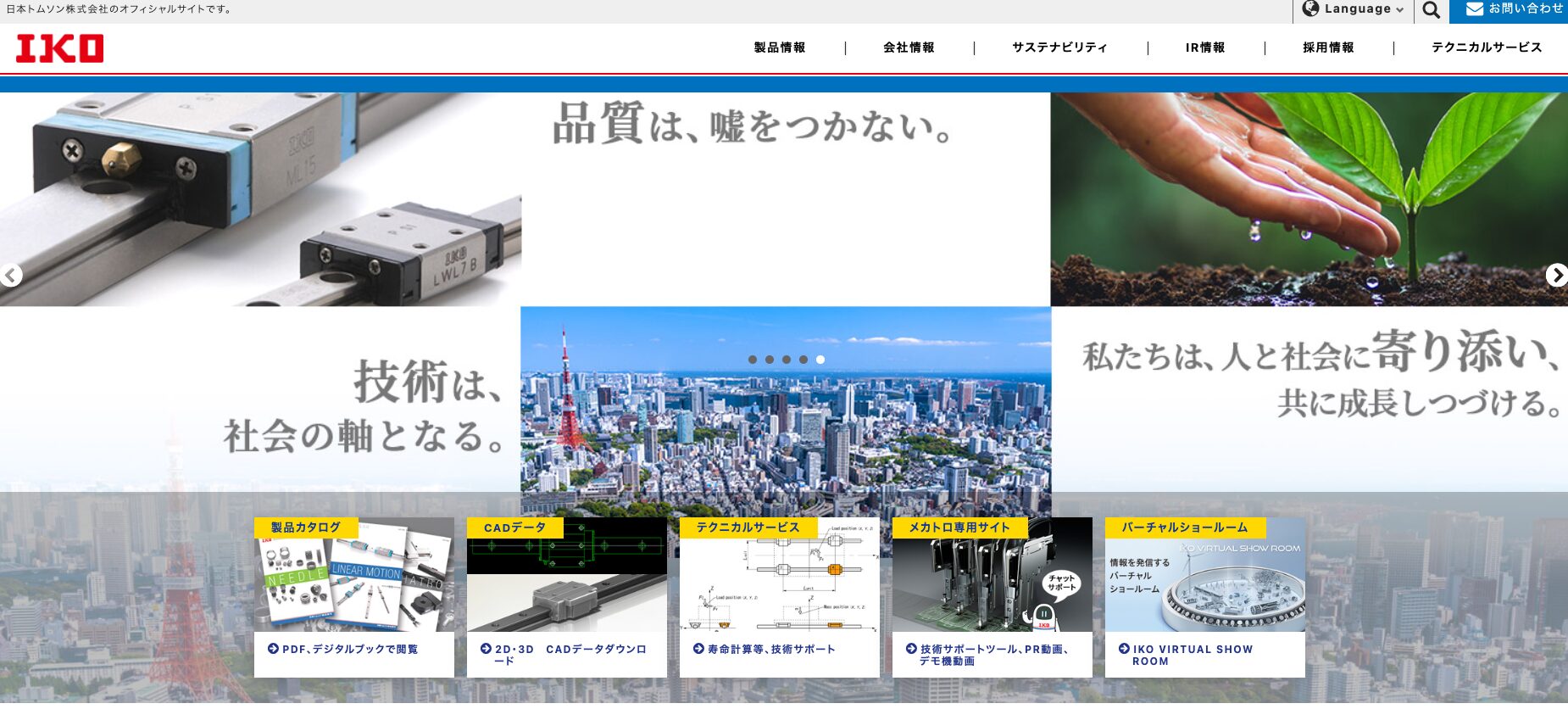
Nippon Thompson Co., Ltd. is a precision machinery manufacturer engaged in the development, manufacturing, and sales of bearing products such as needle bearings, linear motion guide equipment, and mechatronics products. Under the “IKO” brand, the company offers a wide range of products that contribute to greater precision, miniaturization, and labor-saving in machinery, and these products are used in diverse industrial fields including machine tools, semiconductor manufacturing equipment, electronic component mounting machines, medical devices, and various types of automation equipment. Based on element technologies and quality control systems cultivated over many years, the company stably supplies essential components that support manufacturing in Japan and overseas.
In addition to providing standard products, the company also focuses on proposing optimal products according to customers’ operating environments and equipment specifications, offering solutions that meet performance requirements such as high load capacity, high rigidity, low friction, and long service life. By promoting an integrated approach from product development to production, sales, and technical support, Nippon Thompson contributes to improved equipment performance, greater design flexibility, and enhanced productivity. In the increasingly sophisticated industrial machinery market, the company supports customers’ technological innovation and strengthens the competitiveness of manufacturing sites as a core component manufacturer that enables highly precise motion.
Features
- A precision machinery manufacturer offering needle bearings, linear motion guide equipment, and mechatronics products
- Established adoption record under the “IKO” brand across a wide range of industrial fields, including machine tools and semiconductor manufacturing equipment
- Supports higher precision, miniaturization, and labor-saving needs, contributing to improved equipment performance and optimized design
| 会社名 | NIPPON THOMPSON CO., LTD. |
|---|---|
| 本社 所在地 |
2-19-19 Takanawa, Minato-ku, Tokyo |
NTN CORPORATION
Company / Service Overview
NTN Corporation is a comprehensive mechanical components manufacturer centered on bearings, constant velocity joints, and precision equipment products, providing products and technologies that support society across a wide range of fields, including automobiles, industrial machinery, the aftermarket, and even the renewable energy sector. Based on technologies related to rotation, friction, and lubrication cultivated over many years, the company advances the development of high-quality, highly reliable products and contributes to the evolution and stable operation of diverse industries in Japan and around the world.
In addition, while expanding its business globally, NTN focuses not only on product supply but also on providing solutions that help solve customer challenges and improve productivity. In recent years, in anticipation of structural changes in industry such as electrification, automation, and decarbonization, the company has been working on products for next-generation mobility, renewable energy-related technologies, and service development utilizing sensing and condition monitoring, thereby supporting the realization of a sustainable society through both its technological capabilities and proposal-making strengths as a manufacturing company.
Features
- Advanced technological capabilities and extensive track record centered on bearings and constant velocity joints
- A broad product lineup serving a wide range of industries, from automotive and industrial machinery to the energy sector
- Global supply capabilities and initiatives in next-generation mobility and decarbonization fields
| 会社名 | NTN CORPORATION |
|---|---|
| 本社 所在地 |
1-3-17 Kyomachibori, Nishi-ku, Osaka-shi, Osaka |
MinebeaMitsumi Inc.
Company / Service Overview
MinebeaMitsumi Inc. is a comprehensive manufacturer of precision components with a global business presence, offering high-precision products such as bearings, motors, semiconductors, sensors, connectors, power supplies, and mechanical components. Built on a foundation of ultra-precision machining technology, the company supplies products to a wide range of fields, including automotive, aerospace, medical, information and communications, home appliances, and industrial equipment, and has established a strong track record as a company supporting manufacturing around the world.
Rather than only supplying individual components, the company also contributes to improving product performance, miniaturization, and energy savings for customers through solution proposals that combine multiple core technologies.
In addition, one of its key strengths is the expansion of its business domains as an integrated precision components manufacturer by combining the diverse technologies and product groups acquired through M&A. Leveraging its global production and supply network together with a robust quality management system, the company achieves both stable supply and high quality tailored to customer needs, playing an important role in supporting social infrastructure and advanced industries.
Features
- A comprehensive precision components manufacturer offering bearings, motors, semiconductors, sensors, and more
- The ability to provide solutions by combining ultra-precision machining technology with a diverse product portfolio
- A proven track record of supplying a wide range of industries through a global production and supply network and high-quality management
| 会社名 | MinebeaMitsumi Inc. |
|---|---|
| 本社 所在地 |
4106-73 Oaza Miyota, Miyota-machi, Kitasaku-gun, Nagano |

Which Industries Rely Most on High-Precision Grinding Micro-Shaft Components?
Precision grinding is used for mission-critical parts across aerospace, automotive, and medical industries, where micro-shaft accuracy directly impacts safety, performance, and reliability. Understanding which industries drive demand helps customers align with manufacturers possessing relevant experience and certifications.
Aerospace and Medical Industries: Where Micro-Shaft Precision Is a Safety Requirement
Aerospace and medical industries demand micro-shafts ground to tolerances as tight as +0.00025 inches, where cylindrical grinding and honing processes ensure every component meets strict safety and performance standards.
Automotive and Electronics Industries: High-Volume Demand for Reliable Precision Ground Shafts
The automotive industry relies heavily on centerless grinding for producing large volumes of reliable micro-shaft components, while electronics industries require spindle and cylindrical grinding for precision parts used in motors and actuators.
Emerging Applications Driving New Demand for Ultra-Precision Micro-Shaft Grinding
Robotics, medical devices, and miniaturized equipment are creating new demand for ultra-precision micro-shafts, pushing manufacturers to advance lapping, honing, and centerless grinding capabilities to meet evolving industry challenges.

What Certifications and Quality Standards Should a Japanese Micro-Shaft Grinding Manufacturer Hold?
ISO and IATF Certifications Essential for Precision Grinding Operations
Manufacturers should hold industry-specific certifications relevant to their operations. ISO 9001 establishes the foundation for quality management, while IATF 16949 is essential for suppliers serving the automotive industry. AS9100 certification is required for aerospace applications. These standards ensure that precision grinding processes meet documented quality requirements consistently across every production run.
How Japanese Manufacturers Use Honing, Lapping, and In-Process Gauging to Guarantee Quality
Leading Japanese manufacturers combine honing, lapping, and real-time in-process gauging to guarantee dimensional accuracy. Quality assurance processes are crucial for precision grinding services to ensure tolerance compliance. Honing and lapping remove minimal material to complete surface finishing, while in-process gauging automatically adjusts grinding parameters to maintain tolerances within 0.0002 inches throughout production.
Assessing Production Capacity and Lead Time Reliability for Your Project
Manufacturers must assess production capacity to meet deadlines in precision grinding projects. Evaluate equipment availability, workforce expertise, and scheduling reliability before committing. Reliable partners demonstrate consistent on-time delivery records and transparent communication when challenges arise during your project lifecycle.

How to Choose the Right Precision Grinding Manufacturer in Japan for Your Micro-Shaft Project
Key Capabilities and Processes to Look for When Sourcing Precision Ground Micro-Shafts
Prioritize manufacturers offering centerless grinding, cylindrical grinding, honing, and lapping under one roof. This ensures complete control over all processes, guaranteeing consistent surface finish and dimensional accuracy across components for aerospace, medical, and automotive industries.
Questions to Ask Before Committing to a Japanese Grinding Manufacturer
Ask potential partners the following before finalizing your decision:
- What certifications do you hold relevant to my industry
- What tolerances and surface finishes can you reliably guarantee
- How do you ensure quality across high-volume production runs
- What is your typical lead time and production capacity
- Can you provide references from similar precision grinding projects
How to Get Started: Submitting Drawings and Aligning on Project Requirements
Begin by submitting detailed drawings specifying tolerances, materials, and surface finish requirements. Experienced manufacturers will review your drawings, identify potential challenges, and propose optimized grinding processes to meet your project specifications efficiently.

FAQ
What are the top precision grinding micro-shaft manufacturers in Japan?
Our company is a precision grinding manufacturer. Precision grinding manufacturers use advanced CNC machinery for various materials.
Which Japanese companies specialize in high-precision grinding for micro-shafts?
For customer satisfaction, quality assurance processes are crucial for precision grinding services to ensure tolerance compliance using technology.
What is centerless grinding and how is it used in micro-shaft production?
Workpieces are fed. Centerless grinding enables higher throughput without part fixation, optimizing micro-shaft production.
Which industries rely most on high-precision grinding micro-shaft components?
Useful for fuel pumps. Precision grinding is used for mission-critical parts in aerospace, automotive, and medical industries, like automotive industry.
What tolerances can Japanese precision grinding manufacturers achieve for micro-shafts?
In addition, high-precision grinding achieves tolerances as tight as +0.00025 inches with advanced precision grinding.
How do Japanese grinding manufacturers ensure quality and accuracy in micro-shaft machining?
With a commitment to create accurate parts, high-precision machines can maintain tolerances within 0.0002 inches.
What is the difference between centerless grinding, cylindrical grinding, and lapping processes?
This type is commonly used. Cylindrical grinding is ideal for external surfaces of rotationally symmetric workpieces.
How do I choose a reliable precision grinding manufacturer in Japan for my project?
To support your business, manufacturers must assess production capacity to meet deadlines in precision grinding.
What certifications should a high-precision grinding micro-shaft manufacturer in Japan hold?
Send a message to our shop. Manufacturers should hold industry-specific certifications relevant to their operations.
How does precision grinding compare to other machining processes like milling and turning for small shaft components?
Since our firm was founded, efficiency has improved. Precision grinding is highly reliable and efficient.
Can cylindrical grinding handle both external and internal grinding of shafts?
Secured in a chuck: Cylindrical grinding is ideal for external and internal grinding of complex shafts and tubular parts.
How is internal grinding used for micro-shaft manufacturing?
For example, internal grinding achieves precise dimensions on internal holes.
What is spindle grinding used for?
Across an array of tasks, spindle grinding is best for flat and angled surfaces.
What kind of surface finish does precision grinding provide?
It reduces oil resistance. Precision grinding produces very smooth surface finishes.
Is precision grinding cost-effective for mass production?
In this field, precision grinding is a cost-effective process for large volumes.
How reliable is the precision grinding process for micro-shafts?
As wheels remove material, defects seldom occur during precision grinding processes.
Which automotive parts require precision grinding?
Precision grinding is used in the automotive industry.
How does the aviation industry utilize grinding?
Aviation industry utilizes cylindrical and centerless grinding methods.
Why is precision grinding important for medical instruments?
Precision grinding is essential for manufacturing medical instruments.
Do electrical components use spindle and cylindrical grinding?
Electrical components often require spindle and cylindrical grinding.
How are high-precision bearings manufactured?
Bearings are produced using internal and cylindrical grinding methods.
What is Blanchard grinding and when is it used?
Blanchard grinding is a method for heavy material removal to grind large parts flat.